From time to time you may want to change one of the background settings for a zone, and the setup pages are where you do this. They let you change how the heating works, such as whether a zone is pre-heated, what happens when you press a button on a device in the zone, or how sensitive a Room Sensor is to occupancy. The options you see on a setup page depend on the type of zone and which devices are assigned to it.
To open a setup page:
-
Zone Setup: Go to the zone you want to configure, click on the zone sub-menu, then click 'Zone Setup'.
-
My House Setup: On the My House page, click on the My House sub-menu (on the right of the 'Zones' title bar), then click 'My House Setup'.
Quick actions
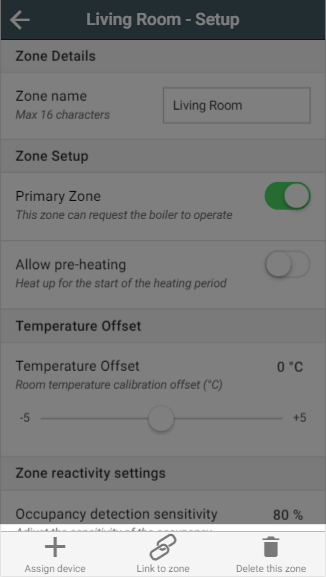
The most common tasks on the setup pages are on the Quick Actions bar at the bottom of the screen.
-
Assign device: Assigns a device that is already added to your system to the zone you are viewing. To assign a device:
-
Click on 'Assign device'.
-
Find the number of the device you want to assign to the zone (this may be printed on a sticker on the device).
-
Select the device and click 'Assign Devices'.
-
-
Link to zone: Links the zone you are viewing to one or more other zones. For more information on linking, see the 'Linked Mode' chapter.
-
Click on 'Link to zone'.
-
Select all of the zones whose schedule you want this zone to follow.
-
Click 'Link'.
-
-
Delete this zone: If you no longer need a zone (for example, if you no longer want to schedule a Smart Plug), click this button to remove it from the app.
Devices already assigned to another zone are not shown in the 'Assign device' list, as a device can only be assigned to one zone at a time.
Setup options
Zone Name (All zones)
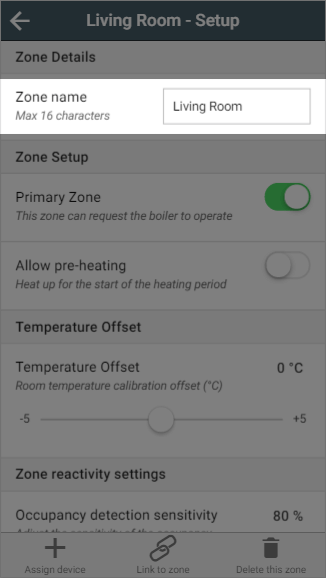
To rename a zone, type the new name in the text box and the app will update.
Manual override (All zones apart from group zones)
In many of your zones, the devices have physical controls you can use to adjust the heating, such as the buttons on a radiator valve. This setting lets you choose whether these controls can affect the heating in the zone, and how. Manual override is disabled by default.
-
When manual override is disabled, button presses on devices are ignored and the zone carries on with its normal schedule.
-
When manual override is enabled, a device can be used to put the zone into Override mode without using the app. When you enable it, you also choose the duration of overrides set from devices in the zone, and the override temperature to use if none is selected on the device.
In My House Setup, you cannot set an 'Override Temperature'. The My House Override uses the temperature selected on the My House Thermostat.
For more information on overriding from devices, see the 'Override Mode' chapter.
Frost protect temperature (Radiator and Underfloor zones)
By default, the frost protection temperature is 4°C. This is the minimum temperature that can be set in any mode for the zone, and the zone will automatically call for heat if its measured temperature drops below it. You might want a higher minimum, for example because of building insurance requirements, concerns about damp, or because parts of the property not controlled by Genius Hub could otherwise get colder than the zones you are controlling.
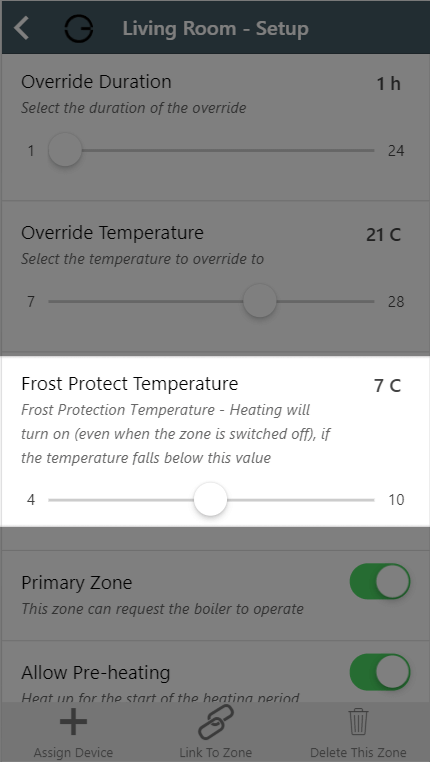
The slider lets you raise the frost protection temperature from 4°C up to 10°C, in 0.5° steps. Raising it changes the Off mode temperature, and the minimum you can select in all other modes, such as Timer and Override.
If an existing schedule has a set temperature below the new frost protection temperature, the Genius Hub will use the frost protection temperature instead.
Primary Zone (Radiator only)
This option decides whether the zone can ask the boiler to switch on when it needs heat. Primary Zone is enabled by default.
If this option is disabled, the zone will only heat up if another (Primary) zone is calling for heat at the same time. If this is the only zone requesting heat, the boiler will not run and the zone will not heat up.
If this option is enabled, the zone will call for the boiler whenever it needs heat, whether or not other zones need heat too.
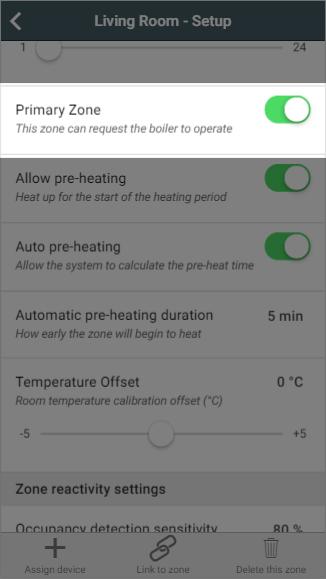
This setting is often useful for a spare bedroom or utility room, where you want the zone to heat up if the boiler is already running, but would not want the boiler to run just for this room.
Enable Valve Shutoff (Radiator only)
When enabled, the Wireless Radiator Valves in the zone are sent the zone's frost protection temperature (4°C by default) whenever the zone is not calling for heat, so the radiator does not heat up.
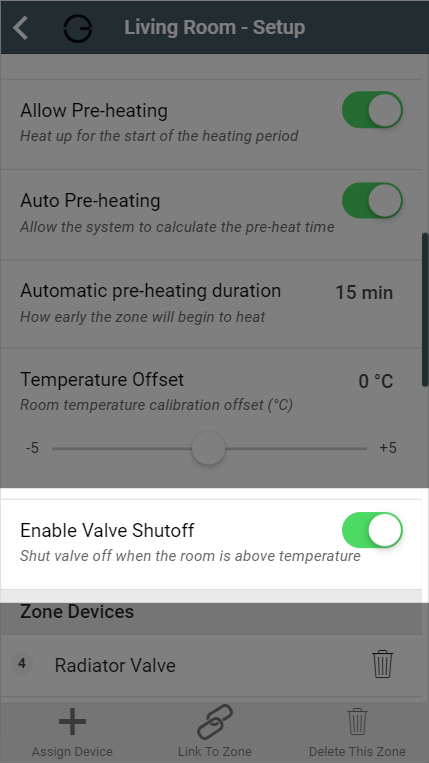
The advantage is that the radiator will not take any hot water from the system once the zone's measured temperature is above its set temperature, even if the valve itself reads a different temperature to another temperature-measuring device in the room. This leaves the hot water for the zones that need it most.
The disadvantages are that it reduces battery life, because the valve moves between open and fully closed more often, and it may be confusing to see the valve showing 4°C (or your frost protection temperature) when this is not part of the schedule.
Pre-heating
The Genius Hub can automatically calculate how long a zone needs to pre-heat, so that it reaches the set temperature at the start of each heating period, rather than only starting to heat up at that time. Pre-heating is disabled by default.
The Genius Hub is adaptive and is always learning from the temperatures recorded by each temperature sensor. Using local weather data and each zone's heating history, it constantly adjusts the pre-heat time as conditions change. The calculated time is based on:
-
the current measured temperature in the zone,
-
the current outside temperature,
-
the target temperature of the next heating period (the default temperature is ignored),
-
the lag time (how long it takes for the zone's temperature to start rising after the heating comes on), and
-
the rise rate (how quickly the zone heats up once its temperature has started to rise).
Pre-heating is only available in heating zones with a temperature-measuring device (such as a Wireless Radiator Valve, Room Sensor or Room Thermostat) assigned to them.
When pre-heating is disabled, the zone is only heated during its heating periods. For example, if you set a heating period from 14:00 to 16:00, the zone will start to heat at 14:00.
When pre-heating is enabled, the zone starts heating before the heating period begins, so it is up to temperature at the start. For example, with the same 14:00 to 16:00 heating period, the zone might start heating at 13:00 so that it reaches its set temperature by 14:00. While a zone is pre-heating, its set temperature is that of the upcoming heating period, not the one currently shown on the timerbars, and the pre-heat symbol lights up to show why the zone is heating early.
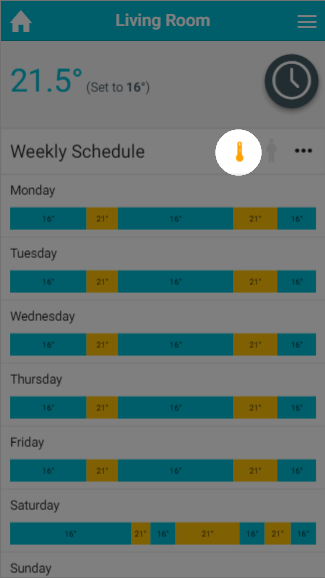
When pre-heating is enabled, there are 2 further options:
-
Automatic pre-heat: The Genius Hub applies its automatically calculated pre-heat time to the zone, based on the set temperature, measured temperature and weather conditions. The time is calculated in real time for the next heating period in the schedule (bear in mind that the next heating period may be tomorrow), and you can check it on the Zone Setup page at any time. If it shows 0 or 5 minutes, the zone is already up to temperature for that heating period.
-
Manual pre-heat: You choose how much earlier than the start of the heating period the zone should begin to heat. This time is always used, however much heating the zone needs to reach the set temperature.
If you set a manual pre-heat time, think about the size of the room and how many external walls it has. A small room will probably heat up quickly, whereas a room on the corner of the property may heat up more slowly because more of its walls are external.
In Footprint mode, pre-heat is limited to a maximum of 90 minutes. For more information, see the 'Footprint Mode' chapter.
Temperature offset
Sometimes the Wireless Radiator Valves and Room Sensors in a zone measure different temperatures. For example, a Room Sensor on an external wall may read low because the wall is cold. If it is not practical to move the Room Sensor, you can apply an offset so the devices read the same temperature.
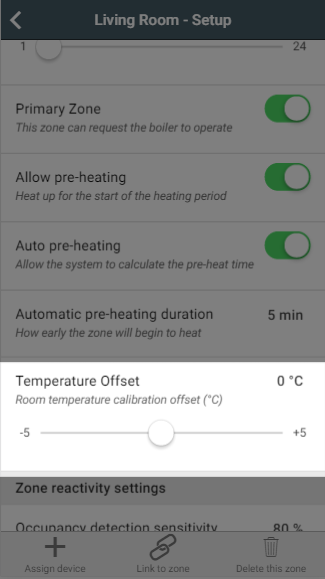
To apply an offset to a zone:
-
Scroll to 'Temperature offset'.
-
Move the slider to the offset you want. The offset is applied straight away.
If the Room Sensor is reading low, the boiler may keep running after the Wireless Radiator Valve has closed. To work out the offset for the zone:
-
Subtract the measured temperature (shown at the top left of the zone page) from the set temperature (shown as 'set' at the top left of the zone page).
-
E.g. measured temperature = 21.5°C, set temperature = 22.0°C, so 22.0 − 21.5 = 0.5.
-
-
Move the slider to the nearest 0.5°C to this value (e.g. +0.5°C). If the Room Sensor reads high rather than low, the result will be negative, so set a negative offset instead.
The Temperature offset applies to the whole zone. To adjust a single Wireless Radiator Valve, use its Valve Hidden Offset on the Devices page instead. See the 'Devices page' chapter.
Zone reactivity settings (Zones with an occupancy device only)
For zones with a Wireless Room Sensor, Wireless Motion Sensor or Occupancy Trigger channel, you can change how the zone reacts to occupancy in Sense and Footprint mode. There are 3 settings:
-
Occupancy detection sensitivity: How sensitive the sensors are to movement in the room. The default is 70%: our testing showed this is sensitive enough to detect small movements from people, but not so sensitive that pets moving about the room trigger the heating. If you find the system is not detecting you when you are in the room, we recommend increasing it by 10% at a time.
-
Heating trigger on after: How many consecutive minutes occupancy must be detected before the heating reacts to someone using the room. The default is 2 minutes, which is long enough to let you walk through the room or get a glass of water, and short enough to bring the heating on quickly once you are using the room.
-
The system needs to see occupancy in every consecutive minute to turn the heating on. So if you set it to 5 minutes, it is very hard to bring the heating on, because occupancy will need to be seen in minute 1 and minute 2 and minute 3 and minute 4 and minute 5.
-
-
Heating trigger off after: How long occupancy must not be detected before the heating switches off. The default is 20 minutes, which is long enough to pick up small movements while you are sitting watching TV, or to cover leaving the room for a couple of minutes to answer the door, and short enough that the heating won't keep running long after you have stopped using the room.
Setting the occupancy detection sensitivity above 90% may result in false triggers.
Temperature measurements
With Temperature Hierarchy, you can choose which temperature-measuring device in a zone takes priority, or let the system choose for you.
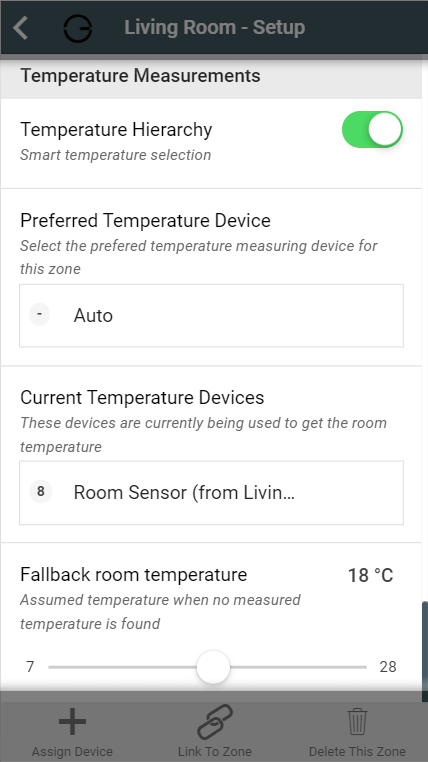
Every zone that controls to a temperature (Radiator, Underfloor and Hot Water Temperature zones) needs to know its current temperature to decide whether to heat further.
If a zone has only one temperature measurement, that measurement is used directly. If there are several, the system needs to work out a single temperature to control to:
-
Temperature Hierarchy enabled: The system uses the temperature from a single device, using an algorithm to choose the device most likely to give the best temperature for the zone.
-
Temperature Hierarchy disabled: The system averages the measured temperatures, shows this average in the app, and uses it to decide when the zone calls for heat.
When Temperature Hierarchy is enabled, the device the system has chosen is shown in the 'Current Temperature Devices' section. If you would rather choose the device yourself, click on the button under 'Preferred Temperature Device' and select the device you want.
For more information, see How Temperature Hierarchy works.
Fallback room temperature
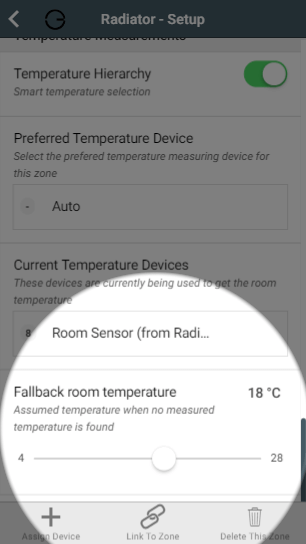
This is the temperature the zone uses to decide whether to bring on the heating if there is no usable temperature measurement (for example, if the batteries in all the relevant devices have run out). When a zone is using its fallback temperature, a warning is shown on the System tile of the My House page, along with errors for any devices with dead batteries.
-
If you want the zone to keep heating to its normal schedule while it is using the fallback temperature, set the fallback temperature above the default temperature but below the heating period temperatures for the zone.
-
If you are using Footprint mode, set the fallback temperature above the away temperature and below the active temperature.
-
-
If you do not want the zone to heat up when there is no working temperature-measuring device, set the fallback temperature below all of the set temperatures for the zone.
-
The default fallback temperature is 18°C.
Zone devices (All zones)
This shows the devices assigned to the zone. For example, a Radiator zone will have one or more Wireless Radiator Valves and probably a Room Sensor. Each device is listed with a button to remove it.
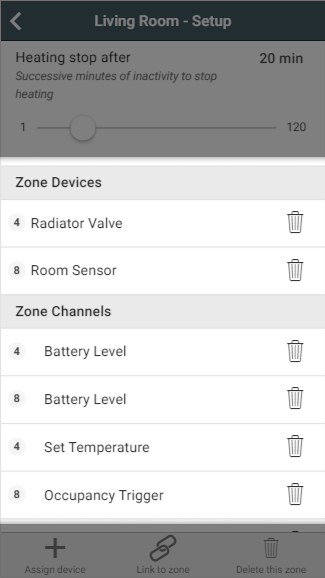
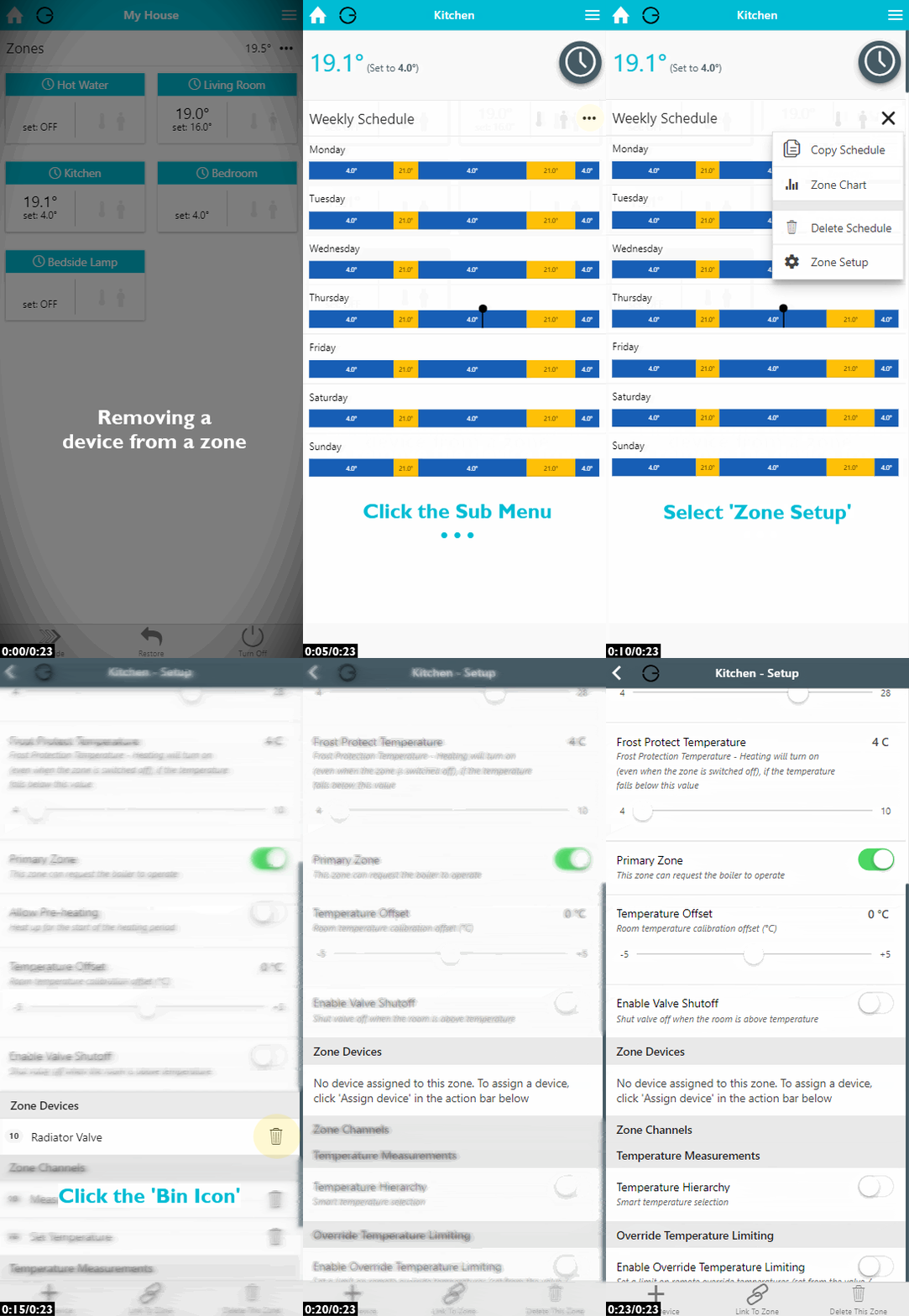
To remove a device from the zone:
|
Demonstration |
|---|
|
-
Scroll to 'Zone Devices'.
-
Click on the Bin icon next to the device you no longer want assigned to the zone.
This only removes the device from the zone. The device stays added to your system.
-
If a zone has no devices assigned, a message will confirm that the zone is not controlling any devices.
-
Each device is made up of channels, such as 'Battery Level' and 'Measured Temperature'. For more information, see What do the Device Channels mean.
Override Temperature Limiting
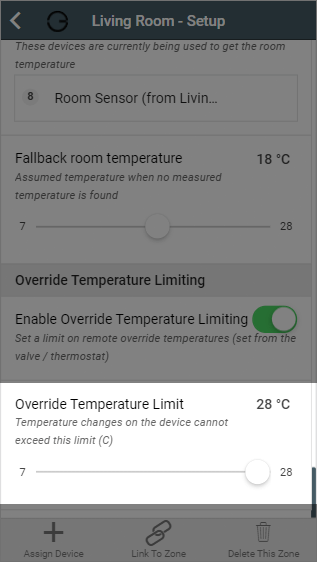
The app user has full control of the system, but in some situations you may not want the occupants of a room to have as much control. This option lets occupants turn the heating on outside of the normal schedule using the device in the room, but only up to a set maximum temperature.
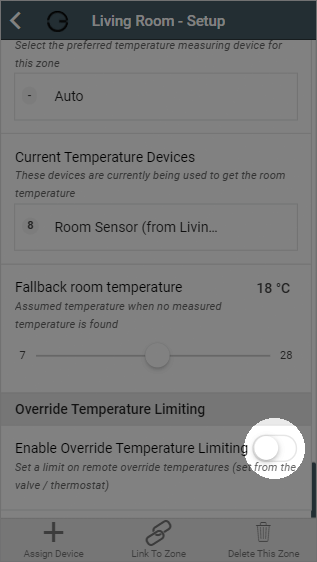
To enable this feature:
-
Scroll to 'Override Temperature Limiting'.
-
Click the toggle to enable the feature.
-
Move the slider to the maximum temperature you want to allow for manual overrides.